Early Bird Specials:
- Scroll down below for promotional details for each departure date
Day 1: In the afternoon we embark our vessel in Ushuaia
In the afternoon, we embark in Ushuaia, Tierra del Fuego, Argentina, the southernmost city in the world located at the Beagle Channel and sail through this scenic waterway for the rest of the evening.
Day 2: At sea
Day 3: Falkland Islands
Falkland Islands – We spend this day in the Western parts of the Falkland Islands (Malvinas). If the weather conditions are good, we plan a landing on the rarely visited Steeple Jason Island on which the largest Black-browed albatross colony in the world is located (app. 113.000). A true expedition landing. As an alternative, we would take a walk along the Coast of Carcass Island. Here we may encounter breeding Magellanic and Gentoo penguins, but also numerous waders and passerine birds are present. On Saunders Island, we can see the majestic Black-browed albatross and their sometimes-clumsy landings near their nesting site along with breeding Imperial shags and Rock hopper penguins. King penguins, Magellanic penguins, and Gentoo penguins are also present here.
Day 4: Stanley, Falkland Islands
Stanley, Falkland Islands - In Stanley, the capital of the Falklands, we can experience Falkland culture, which has some South American characteristics as well as Victorian charm, colourful houses, well-tended gardens, and English style pubs. In Stanley and the surrounding area, we can see quite a number of stranded clippers from a century ago. They bear witness to the hardships of sailors in the 19th Century. The small, but very interesting museum is well worth a visit featuring an exhibition covering the early days of settlement up to the Falklands War of 1982. Approximately 2,100 people live in the small capital in which all passengers are free to wander around on their own. Admission fees to local attractions are not included.
Day 5 - 6: At sea
At sea - On our way to South Georgia we will cross the Antarctic Convergence.
Day 7 – 10: South Georgia
South Georgia - In the early afternoon of day 8 we arrive at our first landing site in South Georgia. One of many highlights is a visit to Prion Island (the island is closed for visitors during breeding season from 20 Nov – 07 January), where the previous summer’s fully grown chicks of the huge Wandering Albatross are almost ready to fledge and adults are returning to seek their old partner after a year and a half at sea. Salisbury Plain, St Andrews Bay and Gold Harbour do not only house the three largest King penguin colonies in South Georgia but are also three of the largest breeding beaches for Southern Elephant seals in the world. Only at this time of the year they peak in their breeding cycle. Watch the incredible spectacle of large 4 ton bull’s keep a constant vigil and occasionally fight over territories of dozens of females who have just given birth or are just about to deliver. The beaches are packed with Elephant seals!In Fortuna Bay penguins and seals inhabit the beaches. We may follow the final section of Shackleton’s route to Stromness, the abandoned whaling village. The route leads us across the mountain pass past the “Shackleton Waterfall”. The terrain is partly swampy and some small streams may be crossed along the way (hiking boots or sturdy rubber boots recommended). At Grytviken, we will also see an abandoned whaling station, where King penguins now walk in the streets and Elephant seals have taken residency. Here we will also offer a visit to the Whaling History Museum as well as to Shackleton’s grave nearby.
Day 11: At sea
At sea - Where the ship is again followed by a multitude of seabirds. At some point we might encounter sea-ice, and it is at the ice-edge where we might have a chance to see some high-Antarctic species like the South Polar Skua and Snow Petrel.
Day 12: South Orkney Islands
South Orkney Islands - We are planning on a visit to Orcadas station, an Argentinean base located on Laurie Island in the South Orkney Island archipelago. The friendly base personnel will show us their facilities and we can enjoy the wonderful views of the surrounding glaciers. Alternatively we may attempt a landing in Shingle Cove on Signy Island.
Day 13-14: At sea towards Antarctica
We will pass large icebergs and have a good chance of Fin whales on the way south. Also we have the best chances on the trip to see Antarctic Petrels around the ship.
Day 15 - 16: Antarctic Peninsula
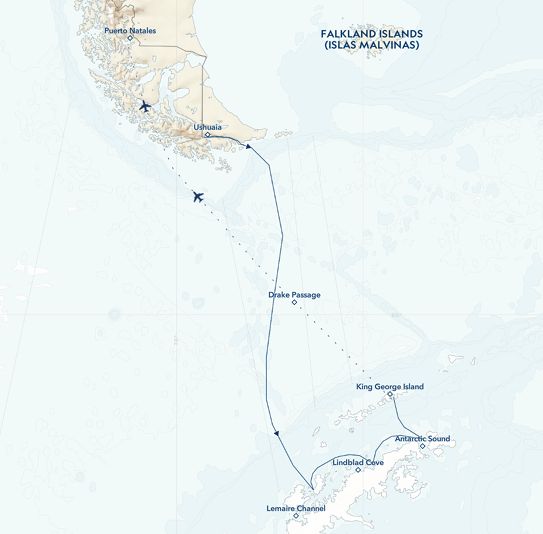
Antarctic Peninsula – If the ice permits we will sail into the Weddell Sea through the ice-clogged Antarctic Sound. Huge tabular icebergs will announce our arrival to the eastern side of the Antarctic Peninsula. We plan to visit Paulet Island with a huge number of Adélie penguins and Brown Bluff where we may set foot on the Continent. In good sailing conditions we may decide to extend our time in the Weddell Sea. The volcanic islands of the South Shetlands are windswept and often shrouded in mist, but do offer subtle pleasures. There is a nice variety of flora (mosses, lichens and flowering grasses) and fauna, such as Gentoo Penguins, Chinstrap Penguins and Southern Giant Petrels. On Half Moon Island we will find Chinstrap Penguins and Weddell Seals often haul out on the beach near the Argentinean station Camara.In Deception Island our ship braves into the entrance of the crater through the spectacular Neptune’s Bellows. Deception itself is a sub-ducted crater which opens into the sea creating a natural harbour for the ship. Here we find hot springs, an abandoned whaling station, thousands of Cape Petrels and many Kelp Gulls, Brown and South Polar Skuas and Antarctic Terns. Wilson’s Storm Petrels and Black-bellied Storm Petrels nest in the ruins of the whaling station in Whalers Bay. The 20 night’s voyage opens the opportunity to sail further down the western Antarctic Peninsula.
In Neko Harbour or Paradise Bay we will have the opportunity to set foot on the Antarctic Continent in a magnificent landscape of huge glaciers calving at sea level. We enjoy the landscape surrounded by alpine peaks. In this area we have good chances to see Humpback Whales and Minke Whales. After sailing through the Neumayer Channel, we hope to get a chance to visit the old British research station, now living museum and post office at Port Lockroy on Goudier Island. Close to Port Lockroy we may also offer a landing on Jougla Point with Gentoo Penguins and Blue-eyed Shags. If ice conditions allow we may opt to venture as far south as the Lemaire Channel to explore the opportunities for landings. In the early hours of our last landing day we hope to land at Cuverville Island with the several thousand Gentoo penguins in the largest Gentoo rookery of the Antarctic Peninsula. We depart to the Drake Passage around noon of day 18 through the Melchior Islands.
Day 17 – 18: At sea
At sea - On our way north we are again followed by a great selection of seabirds while crossing the Drake Passage.
Day 19: Ushuaia
Ushuaia - We arrive in the morning in Ushuaia and disembark.
Note: Nov 3 2026 (Hondius), Nov 5 2027 (Hondius) has two extra days. Please contact us for details.