Early Bird Specials:
- Scroll down below for promotional details for each departure date
- Exclusive Onboard Credit of $200 pp
Day 1: Arrive in Buenos Aires, Argentina
Upon arriving in this cosmopolitan city, known for its architecture and rich European heritage, you will independently transfer to your group hotel, which is in your Charter Flight and Hotel Package.
Day 2: Fly to Puerto Madryn and Embark
Following breakfast at our hotel, we will transfer to the airport for our charter flight to Puerto Madryn, in the Patagonian province of Chubut on Argentina’s stunning Atlantic coast. Upon arrival in Puerto Madryn, your checked bags will be transferred directly to your cabin on Ultramarine, leaving you free to explore this lively Patagonian port town.
Day 3 & 4: At Sea: Getting to know your ship and fellow travelers
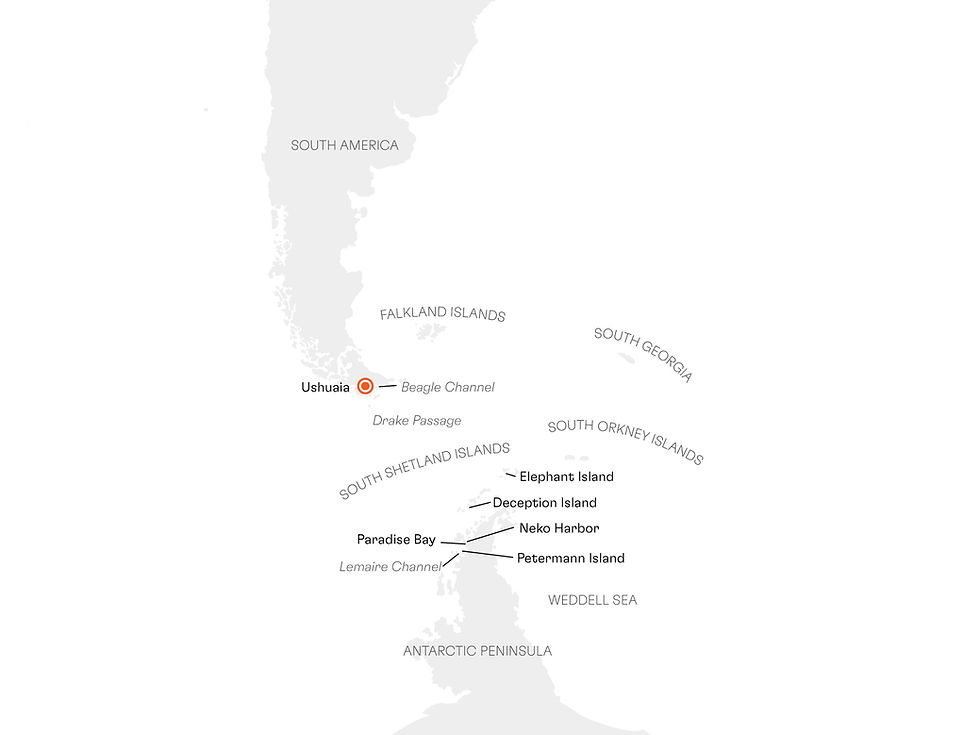
From Puerto Madryn we set our course for Islas Malvinas, also known as the Falkland Islands, where we aim to dedicate at least three days to exploration.
Day 5 to 7: The Falkland Islands (Las Malvinas)
With extended time in the Falklands, we’ll seek opportunities to visit seldom explored sites renowned for birdlife and beauty. Our destinations will depend entirely on weather and marine forecasts, as the outer Falklands are exposed to oceanic swells. We’ll choose locations that offer the best—and safest—conditions for exploration. One such site is the small, slender Steeple Jason, one of the most northwesterly islands in the Falklands. Difficult to access, it has been featured in numerous wildlife documentaries for its prolific black-browed albatross colony—the largest in the world, with an estimated 100,000 to 180,000 breeding pairs. It’s truly a sight to behold.
Our explorations may also take us to New Island, just over thirty nautical miles south of Steeple Jason. A paradise for birders, this small island boasts coves with white sandy beaches sheltered from the open ocean, and is considered one of the most beautiful in the Falklands. Around 25,000 to 30,000 black-browed albatross nest here, joined by Magellanic, gentoo, and southern rockhopper penguins—each with its own distinct nesting style.
Other wilderness destinations may include bird-rich West Point and Saunders Islands in the western Falklands. Saunders Island will amaze you with its long white-sand beaches, the northern shore stretching for kilometers and facing the open sea. It’s almost surreal—particularly if you’ve encountered penguins in ice-and snow laden Antarctica on previous voyages— to watch gentoo, Magellanic, and southern rockhopper penguins making their way to the water along sandy stretches. There’s also a smaller colony of black-browed albatross nests on a nearby cliff, sharing the gently sloped, grassy island with grazing sheep tended by the warm-hearted Saunders family. Look for Commerson’s dolphins, often spotted in the shallow waters near Saunders’ sandy beaches.
West Point Island is another Falkland gem, with vibrant green vegetation and blooming spring flowers. From the rocky beach, a gentle walk (with slight elevation) leads through a picturesque meadow to a cliff where black-browed albatross nest. West Point Island is home to 2,000 breeding pairs. We’ll visit a small section of the colony for intimate views of albatross in their nests and soaring above the waters.
Like Saunders and New islands, Carcass boasts stunning white-sand beaches meeting the cold, blue waters of the South Atlantic. Magellanic and gentoo penguins nest here, and the tussock grasses are especially impressive. Look overhead for peregrine falcons soaring high above. No visit to the Falklands is complete without a stop in its largest community— Stanley. Highlights include the museum (admission covered) and the striking arch monument built from the jaws of blue whales.
Day 8 & 9: At Sea: Traversing the Antarctic Convergence
While at sea, we may become aware of our transit over the Antarctic Convergence, or Polar Front. This biological boundary marks where the South Atlantic meets the Southern Ocean, and we’ll notice the change as we cross it.
Day 10 to 15: South Georgia: Galapagos of the South Seas
After enjoying South Georgia from a distance, we’ll head toward its numerous beaches to find a bay for your first excursion. Landing sites are varied, largely determined by the weather conditions. The sites you visit will deliver wildlife encounters unrivaled anywhere else on Earth. Biodiverse South Georgia—often described as the Galapagos of the south seas—is one of the most fertile breeding grounds in the world for sub-Antarctic wildlife, with beaches blanketed with penguins and seals. It won’t take you long to realize that you are in a birder’s paradise, as burrowing seabirds, albatrosses, and petrels can be seen in abundance. You’ll find that South Georgia, once a popular base for whalers and sealers, is also scattered with abandoned relics and evidence of human activity from centuries gone by.
Mid-October and early November are exceptional times to visit South Georgia, especially for wildlife enthusiasts. At this time of year, male elephant seals battle for control of beach sections, securing breeding rights for females entering their territories. These bouts are fought in bursts, with rest periods between clashes. As the largest pinniped species on the planet, watching these giants spar is a true spectacle.
With extra time in South Georgia, we’ll have greater flexibility to explore more sites. If conditions allow, we may visit King Haakon Bay and the very beach where Ernest Shackleton and his party aboard the James Caird landed after their perilous journey from Elephant Island. If not, we’ll spend more time along the island’s leeward coast, aiming to visit its massive king penguin colonies.The largest of these colonies. St. Andrew’s, which—by conservative estimates—is home to more than 150,000 breeding pairs. We’ll also seek out macaroni penguin colonies—conditions permitting—as these birds favor rugged, exposed coastlines. Possible sites include Hercules Bay, Royal Bay, and Cooper Bay. Expect to encounter some of the island’s millions of petrels and prions.
Day 16 to 19: At Sea: Starting the Journey Home
To say that South Georgia is remote would be an understatement, and as such, we’ll need to invest the necessary time to travel the more than 1,000 nautical miles on our return to South America. We’ll begin our westward journey through the Southern Ocean, crossing back over the Antarctic Convergence and passing near Burwood Bank—a shallow underwater plateau surrounded by deeper waters. All three of these dynamic regions can provide opportunities for bird-watching and marine mammal sightings, and we’ll feel the gradual shift from the chillier ecological Antarctic to the somewhat warmer environments of Tierra del Fuego.
Day 20: Disembark in Ushuaia and Fly to Buenos Aires
We will arrive in Ushuaia in the morning and disembark after breakfast. You will be transferred to the airport for the return group charter flight to Buenos Aires, which is part of your Charter Flight and Hotel Package.
Note: Ocean Explorer's Oct 13 2028 departure starts at Puerto Madryn and ends at Ushuaia. Please call us for details.