Early Bird Specials -
- Early Bird Savings available
Please click "Prices and Departures" tab above for departure dates and cabin details.
Day 1: Buenos Aires
Charter flight from Buenos Aires to Ushuaia/Argentina, departure 18.00 hrs
Day 2: Drake Passage
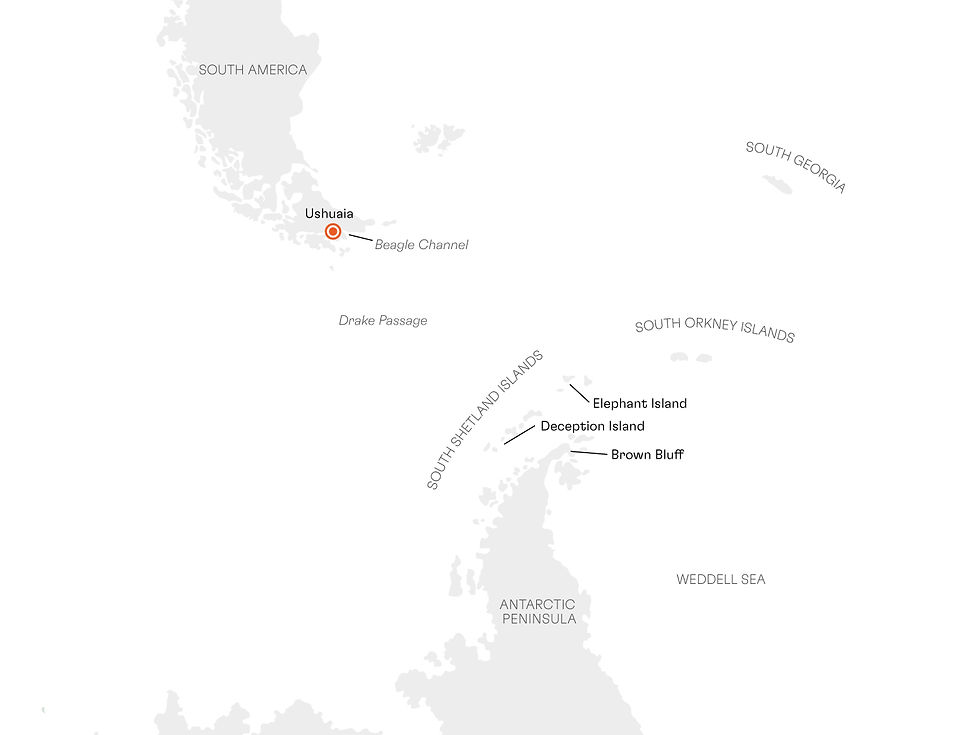
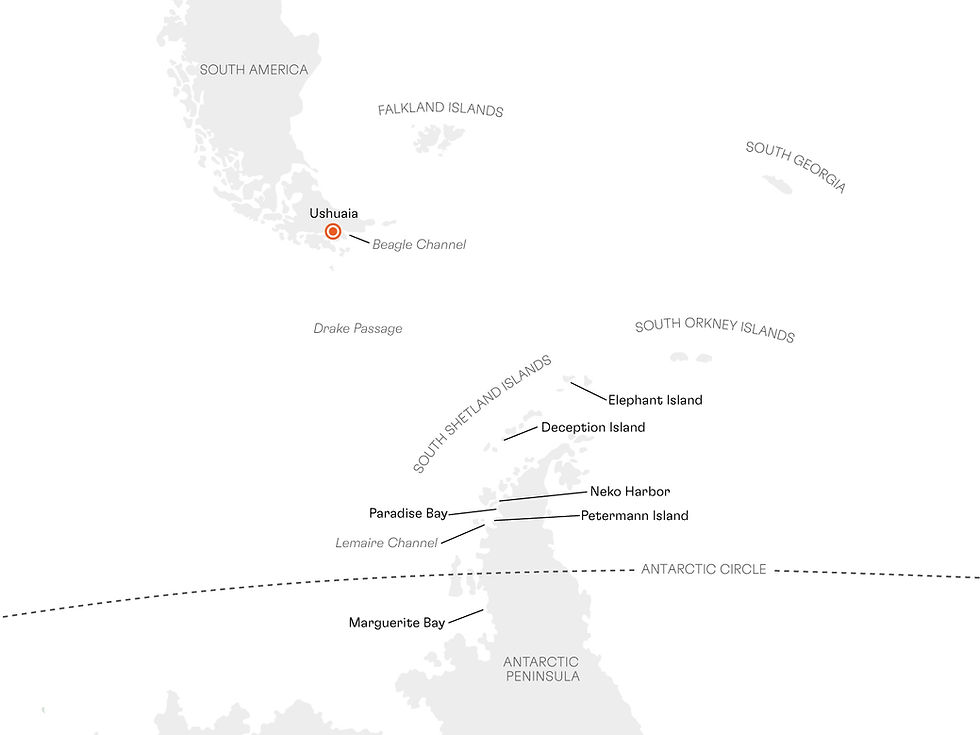
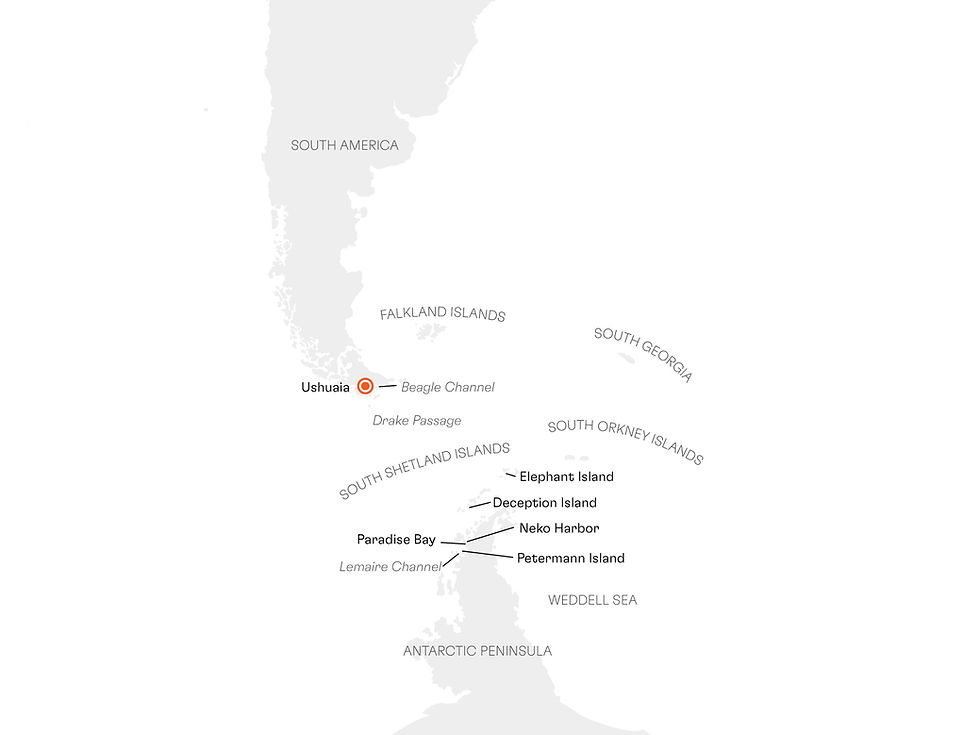
Days 3-8: South Shetland Islands , Antarctic Peninsula, Crossing the Antarctic Circle, Marguerite Bay
The South Shetland Islands form a long chain in the ocean. The island group opens up exciting chapters of Antarctic exploration and provides expert insights into geology.
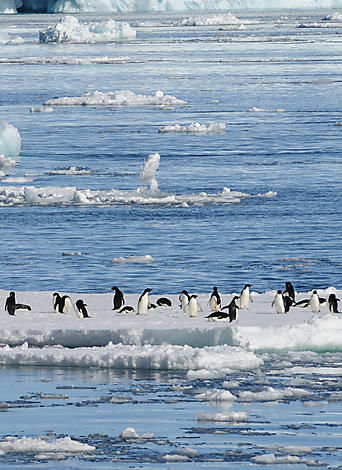
The Antarctic Peninsula, part of the coldest continent on Earth, may seem inhospitable at first glance, but it is actually a paradise for countless animal species that have adapted perfectly. Enjoy unforgettable moments when, for example, you set foot on the Antarctic mainland near to Paradise Bay. Snow-covered peaks, imposing icebergs and towering glaciers surround you. Unbelievable views also await you in the bay of Neko Harbor with its rocky massifs. On Petermann Island, keep an eye out for gentoo and Adelie penguins and the blue-eyed cormorants that have their breeding colonies here. One of the most impressive shipping passages in the world is the Lemaire Channel: mountains up to 1,000 m (3,281 ft) high line the strait of water.
As the ship heads south, the endless white seems increasingly rough and icy. The excitement on board mounts as you approach the crossing of the Antarctic Circle – a unique feeling of pioneering adventure. How far can the ship advance? Thick ice fields and icebergs are a common sight here and the glaciers seem more dominant. In this challenging region, the experience and flexibility of the captain and crew are needed more than ever.
With the highest ice class for passenger ships, the ship can forge its way to the most beautiful and rarely visited regions such as Marguerite Bay. A steep mountain panorama, possibly covered in fresh snow, as well as vast snowfields and glaciers spread out before you. On Zodiac rides and hikes with your experts, you will gain insights into a world of ice that few have experienced. Simply magical.
Days 9-17: Relaxation at sea/cruise through Bellingshausen Sea, Amundsen Sea and Ross Sea (Feb 8 will be lost due to crossing the International Date Line)
The next few days in the southernmost regions of the world will be devoted to the golden age of Antarctic exploration. This is not a route from A to B – it is a way to rediscover Antarctica in the tradition of legendary explorers. Simply incredible – the Bellingshausen Sea covers an area of several hundred square kilometres and is around 4,000 m (13,123 ft) deep. The excitement builds on board: what are the ice conditions in the Ross Sea? How will the natural surroundings look? Can the captain push through the pack ice and drifting ice to reach seldom-visited regions? If all goes to plan, you will experience unforgettable and moving moments.
Days 18-23 Ross Island , Terra Nova Bay , Victoria Land
The season is ideal, the timing perfect – your ship will attempt to make its way through the pack ice and drifting ice to get to Ross Island. You can expect to see whales and emperor penguins in this region. If the weather and ice conditions allow a landing, you will be able to visit legendary places such as Cape Royds: the spot where Sir Ernest Shackleton set up a base camp for his South Pole expedition in 1908 is now home to penguins. Cape Evans, by contrast, set the scene for the Terra Nova expedition led by Robert Falcon Scott, who attempted to beat Roald Amundsen to the South Pole. Find out more about today’s research in the area at the American McMurdo Station, the largest research station in the Antarctic (subject to authorisation). In the shadow of the modern building and the mighty Mount Erebus stands the historic Discovery hut built by Scott in 1902.
Terra Nova Bay was named after the ship that Scott was sailing in when he discovered the bay in 1901. It is now home to an Italian research station. On his expedition, Scott came across the enormous Drygalski Ice Tongue: at between 14 and 24 km (8.7 to 14.9 mi.) wide and around 50 km (31 mi.) long, this wall of ice will seem particularly impressive from the Zodiacs.
Another indescribable highlight awaits as you cruise in front of the fantastic backdrop of the Ross Ice Shelf: the gigantic wall of ice as tall as houses stretches for hundreds of kilometres. Victoria Land, on the other hand, welcomes you with an endless expanse. At Cape Adare, you will find the ruins of a hut that Borchgrevink built in 1899 and in which an expedition team spent a winter in Antarctica for the first time. The spectacular wildlife here is just as moving as the region’s past – including the largest colony of Adelie penguins in Antarctica with over 250,000 breeding pairs.
Day 24 Relaxation at sea
Day 25 Cruising off the Balleny Islands/New Zealand (subject to final approval)
On your cruise, you will come across untouched island worlds with a rich fauna that are hardly known in our latitudes. Nature conservation is playing an increasingly important role in their preservation, which is why permits are becoming more and more complex. Destinations in New Zealand depend on whether the authorities grant their permission. If they give the green light, you will be able to enjoy mystical views when cruising off the Balleny Islands, as steep cliffs rise suddenly from the sea. And colonies of Adelie and chinstrap penguins fill the largely glaciated island group with life.
Days 26-27 At Sea
Days 28-30 Cruising off the subantarctic islands of New Zealand (Subject to final approval)
New Zealand's Subantarctic Islands seem to have been forgotten by the rest of the world. Their wildly romantic, unspoilt landscapes are a UNESCO World Heritage Site and enjoy the highest protection of any nature reserves in New Zealand. Landings depend on authorisation from the authorities, who aim to keep the islands free from invasive species. Heather and wild flowers give Campbell Island a special kind of charm. The island is home to the world’s largest breeding colony of southern royal albatrosses. The Auckland Islands are not only home to yellow-eyed penguins and New Zealand sea lions, they also have the lushest flora of all the islands. The Snares penguin, meanwhile, is only found on the Snares Islands, alongside Cape petrels and albatrosses.
Day 31 Stewart Island/New Zealand
Stewart Island, 30 km (18.6 mi.) south of the South Island, is New Zealand’s third-largest island. A natural canvas featuring dense forests, countless bays and mountains, such as Mount Anglem, at a height of around 980 m (3,215 ft). There are signs that the Maori settled here in the 13th century, long before the first European, James Cook, discovered the island in 1770.
Day 32 At Sea
Day 33 Lyttelton (Christchurch)/New Zealand, arrival 06.00 hrs